
Acton Remembers Its Hidden Rivers: The Story Behind the Stirling Gardens Mural
Acton Remembers Its Hidden Rivers: The Story Behind the Stirling Gardens Mural
A 12-metre public artwork on the side of Prime Phenix’s new Stirling Gardens development in Acton is doing something remarkable: it’s bringing two lost rivers back to the surface, and reconnecting a neighbourhood with the history hidden beneath its streets.
Beneath the Streets of Acton, History Flows
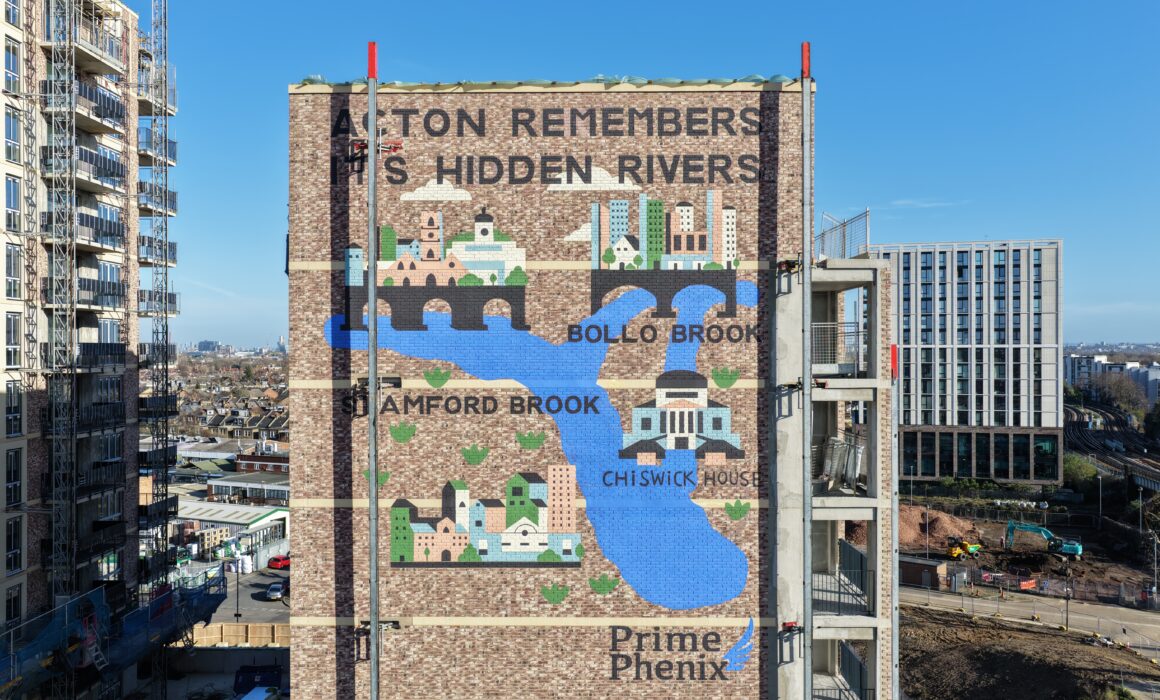
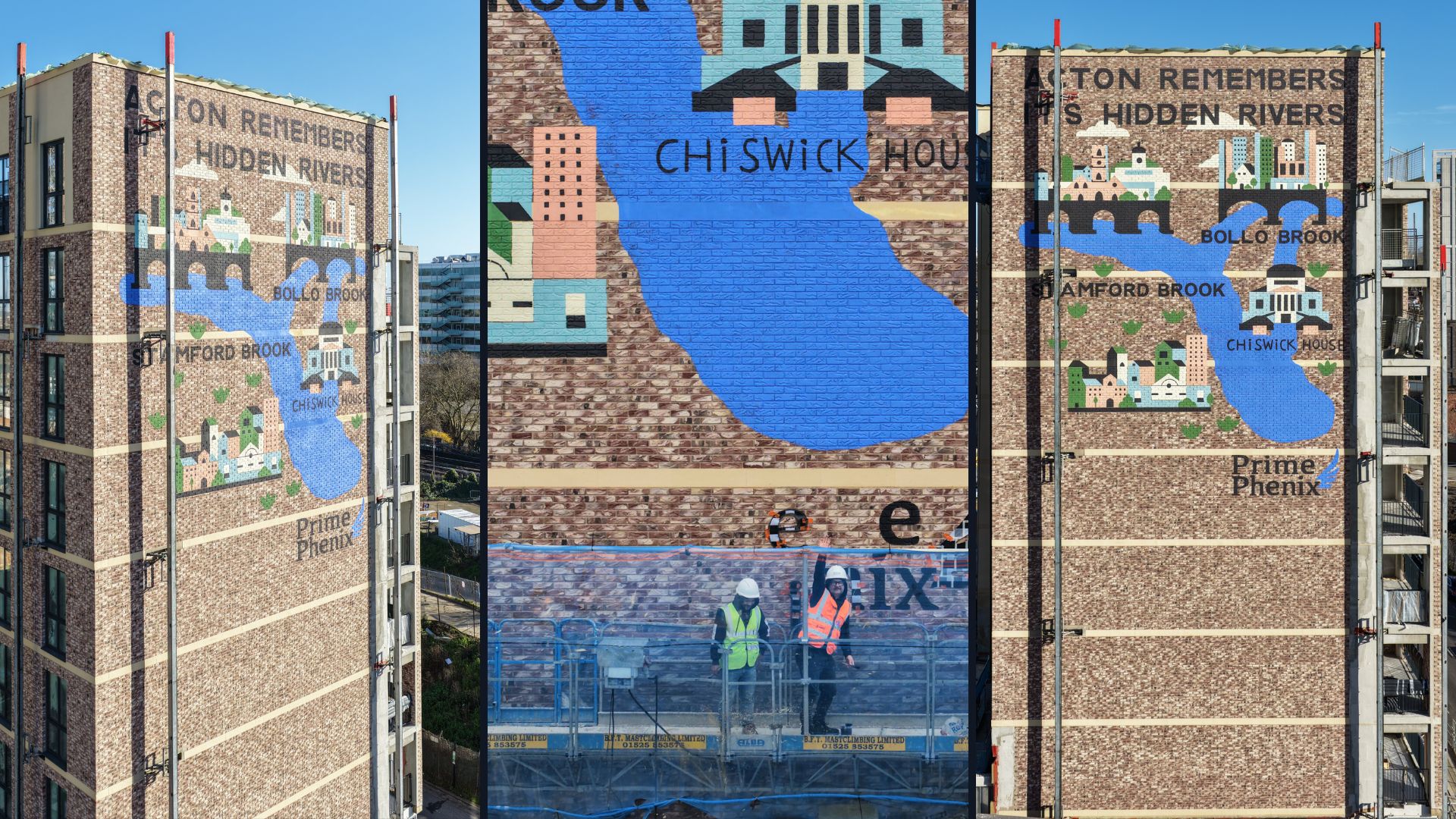
If you walk past Stirling Gardens on Bollo Lane in Acton, you’ll see something you won’t find on any map: two rivers. Not real water, but a large-scale public mural that traces the forgotten paths of Bollo Brook and Stamford Brook, two waterways that once shaped this part of West London before being buried beneath the city’s expanding streets.
The artwork, commissioned by property developer Prime Phenix and created by London-based artist and illustrator James Daw, covers the top four floors of the Stirling Gardens building, approximately 12 metres wide and 13 metres tall. It has become an instant landmark, and the story behind it is one of the most compelling pieces of community-led public art to arrive in Acton in decades.
“Once a river ran here. Beneath our feet, history flows.” — The campaign behind the mural.
What Are Acton’s Hidden Rivers?
West London has a natural history that most people walk over every day without knowing it. Beneath Acton’s streets, two rivers still quietly flow, part of a hidden network of waterways that once defined this corner of the city. Their names are Bollo Brook and Stamford Brook, and they belong to this neighbourhood.
Bollo Brook
Bollo Brook rises near Ealing Common and flows east and south through Acton Town, its historic path still traceable along Bollo Lane, before continuing through Turnham Green. Historically, Bollo Brook fed the famous ornamental lakes and fountains at Chiswick House before draining into the River Thames. Today, it runs entirely underground, hidden beneath roads, pavements, and buildings. Most residents have no idea it exists.
Stamford Brook
Stamford Brook has its headwaters in Acton and flows south through the borough before joining the Thames near Hammersmith and Chiswick. For centuries, it defined the landscape of this part of West London, feeding marshes, powering mills, and forming the natural boundaries between parishes. Like Bollo Brook, it was culverted during the Victorian era and now runs in total darkness beneath the city.
Together, these two rivers represent a piece of natural and cultural heritage that has been largely invisible to the residents who live above them. The Stirling Gardens mural sets out to change that.
The Mural: An Illustrated Map of Memory
Prime Phenix wanted the mural to do something meaningful. Not just decorate a wall, but tell a real story, one that connects the people who live here to the history beneath their feet. James Daw was the perfect person to bring that idea to life.
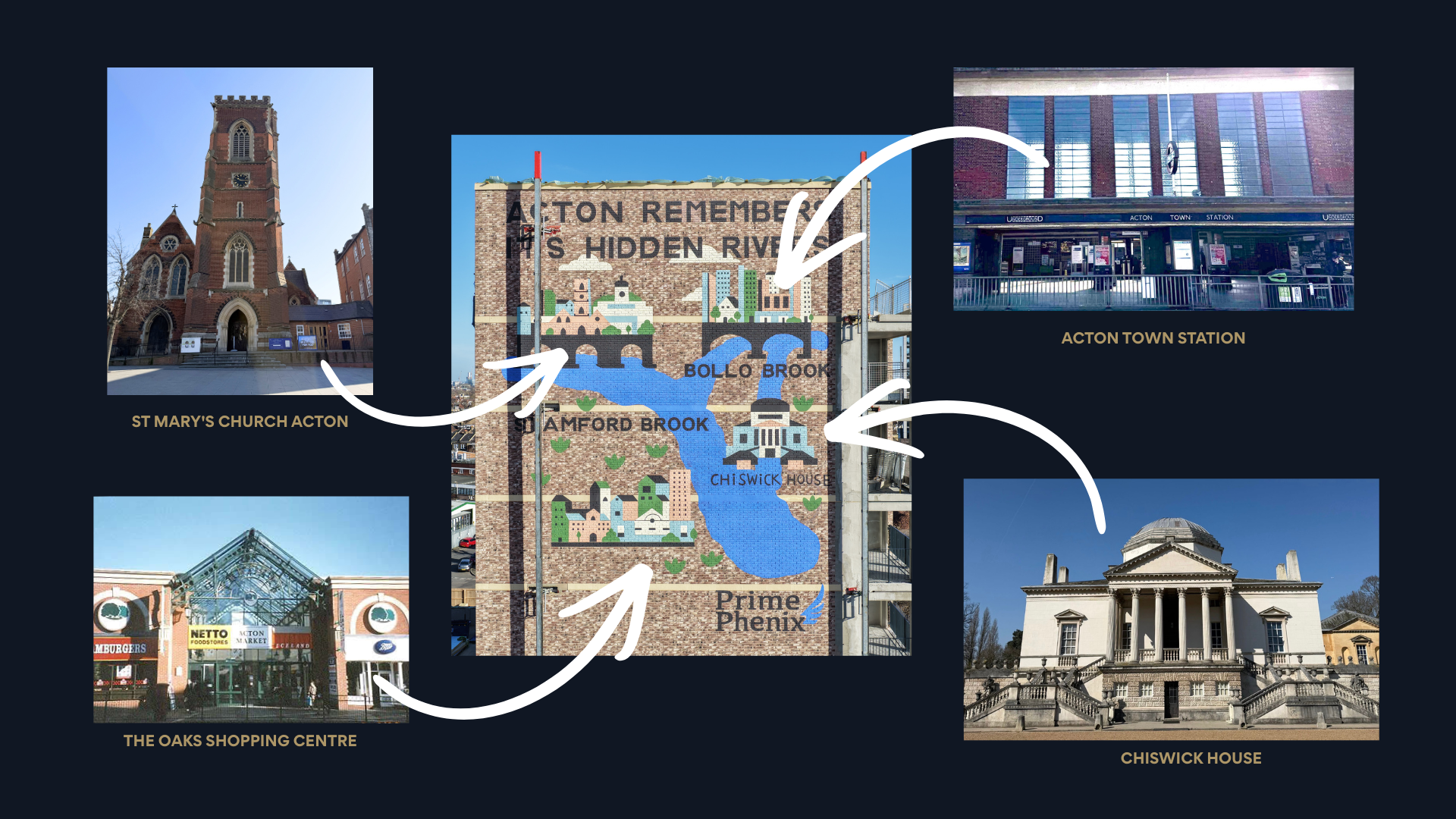
James approached the project the way all his best work begins, on foot. He walked these streets, sketching Acton Town Station, St Mary’s church, and Chiswick House. He traced the routes of the hidden rivers and then he mapped it all onto a single wall.
The result is what James describes as ‘an illustrated map’ — bold, graphic, and rooted in real place and real history. The mural incorporates three key local landmarks:
-
Acton Town Station — the 1930s Charles Holden-designed tube station, a modernist icon at the heart of the area
-
Chiswick House — the Palladian villa whose ornamental lakes were historically fed by Bollo Brook
-
St Mary’s Church, Acton — one of the neighbourhood’s oldest buildings, a constant presence through centuries of change
The rivers themselves flow through the composition, rendered in the illustrative style James is known for — bold shapes, collaged textures, and a graphic quality that reads clearly from street level while rewarding closer inspection.
“I wanted to create an illustrated map, rooted in the streets, the rivers, and the Victorian signwriting that once defined this neighbourhood.” — James Daw, Artist
About James Daw: The Artist Behind the Mural
James Daw is a London-based artist and illustrator whose work spans painting, digital art, and mixed media. A graduate of Camberwell College of Art and Design, part of the University of the Arts London, where he gained a BA Hons in Graphic Design, James worked for many years as an abstract painter before turning his attention to illustration.
His practice is defined by collage and mixed media: textures, scribbles, and marks made by hand, then cut, manipulated, and composed. The result is work that is bold, contemporary, and quirky, always driven by narrative and a distinctive sense of play.
James has collaborated with some of the world’s most recognised brands. He has also been shortlisted for the Ilustrarte Bienial International Children’s Book Competition in Lisbon, the Tapirulan Illustrators Competition in Italy, and the Pictoric competition at Arsenal Book Festival in Kiev. He has been exhibited twice at the Royal Academy Summer Exhibition, one of the most prestigious open exhibitions in the world.
For this project, James brings that same combination of cultural depth and graphic clarity to a community setting, creating work that belongs to the neighbourhood it depicts.
The Thinking Behind This Mural
Prime Phenix is a West London property developer with a simple belief: that new homes should belong to their neighbourhood. Stirling Gardens is the company’s flagship development in Acton, a new residential building designed to become a genuine part of the community it sits within.
The decision to commission a major public artwork was a deliberate one. Prime Phenix wanted Stirling Gardens to contribute something real to Acton, not just new homes, but a cultural landmark that tells the story of the place it stands in.
The hidden rivers theme was chosen precisely because it connects history, ecology, and urban life in a way that is genuinely local. Bollo Brook and Stamford Brook are not generic London stories; they are specifically Acton stories, and they give the mural a meaning that could only exist here.
“Stirling Gardens had to belong to Acton,” says Diba Khani, Marketing Manager at Prime Phenix. “The hidden rivers project is our way of saying we understand this place — its history, its character, and its community.”
Why Public Art Matters for Urban Neighbourhoods
Research consistently shows that public art has a measurable impact on how people experience and feel about their neighbourhood. A 2020 study by the Arts Council found that public art installations in urban areas increase residents’ sense of community by up to 35% and improve perceptions of neighbourhood quality significantly.
For Acton, a borough undergoing significant regeneration, art that is rooted in local history serves an additional function. It creates continuity between what the neighbourhood was and what it is becoming. It tells residents: we see you, we know this place, and we are building something that belongs here.
The Stirling Gardens mural does exactly that. By surfacing the hidden rivers, waterways that most people have never heard of, it creates a new shared reference point for the community. It gives people something to talk about, to explore, and to feel proud of.
Who is Prime Phenix?
Prime Phenix is a West London property developer committed to building homes that are connected to their local community and surroundings. Stirling Gardens in Acton is one of their flagship developments. Prime Phenix commissioned the hidden rivers mural as part of a wider commitment to public art and community engagement.
Visit Stirling Gardens
The Stirling Gardens mural is a permanent public artwork, visible from street level in Bollo Lane in Acton, West London. If you are interested in finding out more about Stirling Gardens, the homes available, or Prime Phenix’s approach to community-focused development, we would love to hear from you.